Showing posts with label Highgate Common. Show all posts

Sunday, 15 April 2012

Highgate Common 03 April 2012

Whilst the rest of the Highgate volunteer work party were building some Dormouse nest boxes for the reserve, myself and another volunteer went out onto the reserve in search of some Emperor Moths (Saturnia pavonia). The males fly in the daytime in search of the females which fly at night. (click on link for photo).

Unfortunately we didn't find any as the weather wasn't on our side. The warm and sunny weather we had been enjoying only the week before had gone and instead we were greeted with a much cooler and greyer day which threatened rain.

It wasn't all doom and gloom though as we did find a total of four Bloody-nosed Beetles (Timarcha tenebricosa)! Pretty good going for the start of April and just rewards for getting absolutely drenched by a torrential downpour just moments late.

Timarcha tenebricosa

Timarcha tenebricosa

Timarcha tenebricosa


Tuesday, 6 December 2011

Highgate Common 6th December 2011

Highgate Common

Today was my first free Tuesday for quite some time and so I took the opportunity to go down to Highgate Common and join their volunteer work party.

It was a chilly day with plenty of frost around first thing but that didn't put me off as I had about 5 layers on to counteract the cold!

We were asked to cut down some Silver Birch (Betula pendula) saplings which were encroaching onto the main heathland area of the Common.

We donned our gloves and hard hats and used both tree loppers and bow saws to remove the saplings and small trees.

I put together a few before and after shots so you can see the progress we made. (as always you can click on the photos to get a bigger picture).

Before
after
before
after
As you can see we kept the big trees and only removed the small ones. As well as temporarily halting the encroachment of Silver Birch in this area it also improved the view from the picnic table.

We didn't see a lot of wildlife while we were working. I did find a Harlequin Ladybird (Harmonia axyridis) on one of the trees we had cut down. When I picked it up to have a closer look it started to excrete a yellow substance from its body. This liquid supposedly has a foul odour, a bit like old leaves (I didn't think to smell it), and is a self-defence mechanism called "reflex-bleeding". Most ladybird species reflex-bleed if agitated to deter predators. It obviously didn't like me disturbing it and soon took flight.

There was a Fly Agaric (Amanita muscaria) mushroom in the area that we were working but unfortunately it was not in a photographic state as it had been stood on and looked rather beaten up.

Cutting down the saplings and then cutting them up into smaller pieces was hot work and I soon had to remove some of my layers. We also had a fire going and this helped to keep us warm.


I played around a little with the colours in the last photo to try and highlight the flames in the fire.

Not all of the wood was burnt; we did set some aside to make a wood pile. The wood pile will provide shelter for a number of animals and invertebrates and as it rots down it will provide food for various invertebrates and their larvae, helping to improve the biodiversity on the site.

Wood set aside for habitat pile


Wednesday, 3 August 2011

Highgate Common 3rd August 2011


Today was very hot (for me that is) and as I don't like the heat I decided to hold off a bit and go for an evening stroll when the temperatures had subsided somewhat. This proved to be a stroke of genius as the evening light over Highgate was just right for some landscape shots. The sky looked lovely too.

We did even more bracken bashing on Tuesday and we found three types of heather in one area. I was hoping to get some photos of the heather this evening but all the cross leaved heath (Erica tetralix) was in shade - not so good for photography.

I did manage to get some photos of the Bell Heather (Erica cinerea) before the sun dropped too low.

Erica cinerea
Erica cinerea
It is quite easy to tell the difference from Bell Heather and Common Heather as the flowers are enclosed in a "bell like" structure on Bell Heather, whilst Common Heather has an open flower. Cross leaved heath has a similar flower structure to the Bell Heather, but the single leaves form a cross shaped grouping of four on the stem. In Bell heather the leaves are in tight clusters, or whorls, of three.

Other sightings of note were a Green Woodpecker, a party of Linnets, a low flying Common Buzzard, a few Tree Pipits flitting around and some Gatekeeper and Small Heath butterflies.

Enjoy the landscape shots below... or don't... it's up to you ;-)


Tuesday, 26 July 2011

Highgate Common 26th July 2011

I went over to Highgate Common again today as part of the volunteer work party that happens there every Tuesday. We were clearing more bracken, a process that will be ongoing for some time yet as there is lots of bracken to get rid of.

In terms of wildlife observations, things got off to a promising start when we were first gathering near the Warden's Office, with Goldfinches in the thistles and a pair of Green Woodpeckers flying past. When we arrived on the common there were lots of butterflies flying around; Gatekeeper, Small Copper, Small Skipper and a Red Admiral were the main ones that I could recognise. There were a couple of white butterflies as well but they didn't settle for long enough for me to get a good look at them.

As we were clearing away the bracken we came across some Common Footman moths that were sheltering in the bracken and tall grasses.

A Great Spotted Woodpecker swooped down into some nearby trees and we could hear both Willow Warbler and Chiffchaff calling from the same trees. A Yellow Hammer was singing some way off and three Common Buzzards were circling high above us.

One of the other volunteers was lucky enough to find a Common Lizard basking in the sun but I managed to miss seeing it.

We did get a little bit distracted today from our normal volunteer work. Some nice people from Natural England and the MP for Staffordshire came to see what we were doing. A photographer also tagged along so maybe you'll see a photo of me holding a scythe somewhere in the not too distant future.

Last Saturday I also went bird ringing over Belvide Reservoir but cold, damp and foggy conditions meant that we only caught 32 new birds. The main highlight was getting to ring a juvenile Bullfinch.

Tuesday, 19 July 2011

Highgate Common 19th July 2011

I went over Highgate Common today to do a bit more volunteer work. A group of us were clearing Himalayan Balsam from a butterfly glade in some woodland, and then we moved on to doing a bit of Bracken clearing.

Whilst working in the butterfly glade I came across a number of Scorpion flies of the genus Panorpa. I managed to get one fairly poor record shot using my phone, but it gives you a fair idea of what it looks like.

 Panorpa Sp.
This is a female scorpion fly. The male's tail looks like that of a scorpion, hence the name. The wings are clear, but with black venation and black markings; the thorax is long with yellow and black markings, but with a red tip; the eyes are reddish-brown and the antennae are very long.

The weather wasn't the best for butterflies but it did warm up enough in the afternoon for us to see Green-veined White, Large White, Small White and Meadow brown.

Friday, 15 July 2011

Highgate Common 14th July 2011

Sorry for the long absence, I've been quite busy lately but I hope to be able to do more frequent blog updates through the end of July and into August as I have some leave booked off from work.

Yesterday I went over Highgate Common once again, but this time I thought I would look at identifying and photographing flowering plants.

One of the quieter parts of Highgate Common

I must admit that I am not overly familiar with flowering plants, which is one of the reasons that I chose to look at them yesterday. I am probably not as bad as some though as I have picked up a bit of the terminology along the way. For example I understand what an inflorescence is and if pressed (and in the possession of a hand lens) I could find a ligule on a grass specimen. However, to a beginner like me, the technical language used to describe the parts, structure and even colouration of a plant can seem overwhelmingly vast and sometimes a little confusing. For instance, I knew that a ligule was to be found at the junction of a leaf blade and leaf sheath on grasses, but until just now (when I was looking up the correct spelling of ligule) I didn't know that it was also the term used to describe the fused petals of a ray floret in a composite!

I find that in comparison, identifying many (but not all) birds is child's play. For a start there isn't as many species.

I now see my lack of botanical skills as a gaping whole in my skill set which needs filling, but even as little as 6 or 7 years ago I remember telling a Travelling Naturalist/Limosa tour group "plants are boring as the don't move". I hope they realised that I wasn't really being serious as I did say it with a smile on my face!

I never thought that this was truly the case, it was more the fact that I find it quite hard to identify plants (because of the reasons above) and I simply couldn't find the motivation to learn.

I understand the need to study and conserve plant life as it is the base to most food chains (bacteria often plays an important part as well, and lets not forget fungi), without it we would all undoubtedly perish.

My increasing interest in arthropods (invertebrates) and the natural world in general has now given me the incentive to learn.

Anyway enough of me waffling on and on to the fun stuff.

I must admit that I couldn't help but get slightly distracted by interesting insects I saw along the way. One of the first things I saw was an interesting brown beetle hanging out on some Ragwort. It was almost certainly a click beetle and was possibly Prosternon tessellatum.

Prosternon tessellatum?
I should point out at this stage that a lot of my photos aren't up to my usual standard. It was quite breezy which made it very difficult to get sharp, in-focus photos :( These are simply the best of a bad bunch. Also it should be fairly obvious that any Latin names with a question mark next to it means that I am uncertain as to the identity of a specimen.

Funnily enough I didn't think to get any photos of the Ragwort, but this is how I knew it was Ragwort and not something else.

Cinnabar moth caterpillar (Tyria jacobaeae)
There were also lots of Common Red Soldier Beetles around (Rhagonycha fulva). Indeed there were so many around that you'll see them in some of my other photos in this post.

Rhagonycha fulva
As Highgate Common is predominantly fragmented heathland with areas of woodland, one plant in particular is fairly common, especially after a lot of hard work from the management team and volunteers to remove invasive braken and trees. Common Heather or Ling (Calluna vulgaris) is now fairly widespread in Highgate, especially in the area I chose to study. There was also small amounts of Bell Heather (Erica cinerea) but I didn't get a photo.

Calluna vulgaris
Calluna vulgaris

In and around the same area I found some Compact Rush growing (Juncus conglomeratus). Rushes and sedges tend to be more spiky and erect than grasses. Compact Rush is relatively easy to identify as the inflorescence forms a tight or "compact" head.

Juncus conglomeratus
There are lots of tracks running through Highgate Common and at one time people could drive their cars right across it. This is no longer the case, but the remaining tracks do open up space for other things to grow. No doubt the sides of these tracks were once a dumping ground for all sorts of rubbish, garden or otherwise, but thankfully that is no longer true. Alongside these tracks there were at least two, if not three, species of thistle growing.

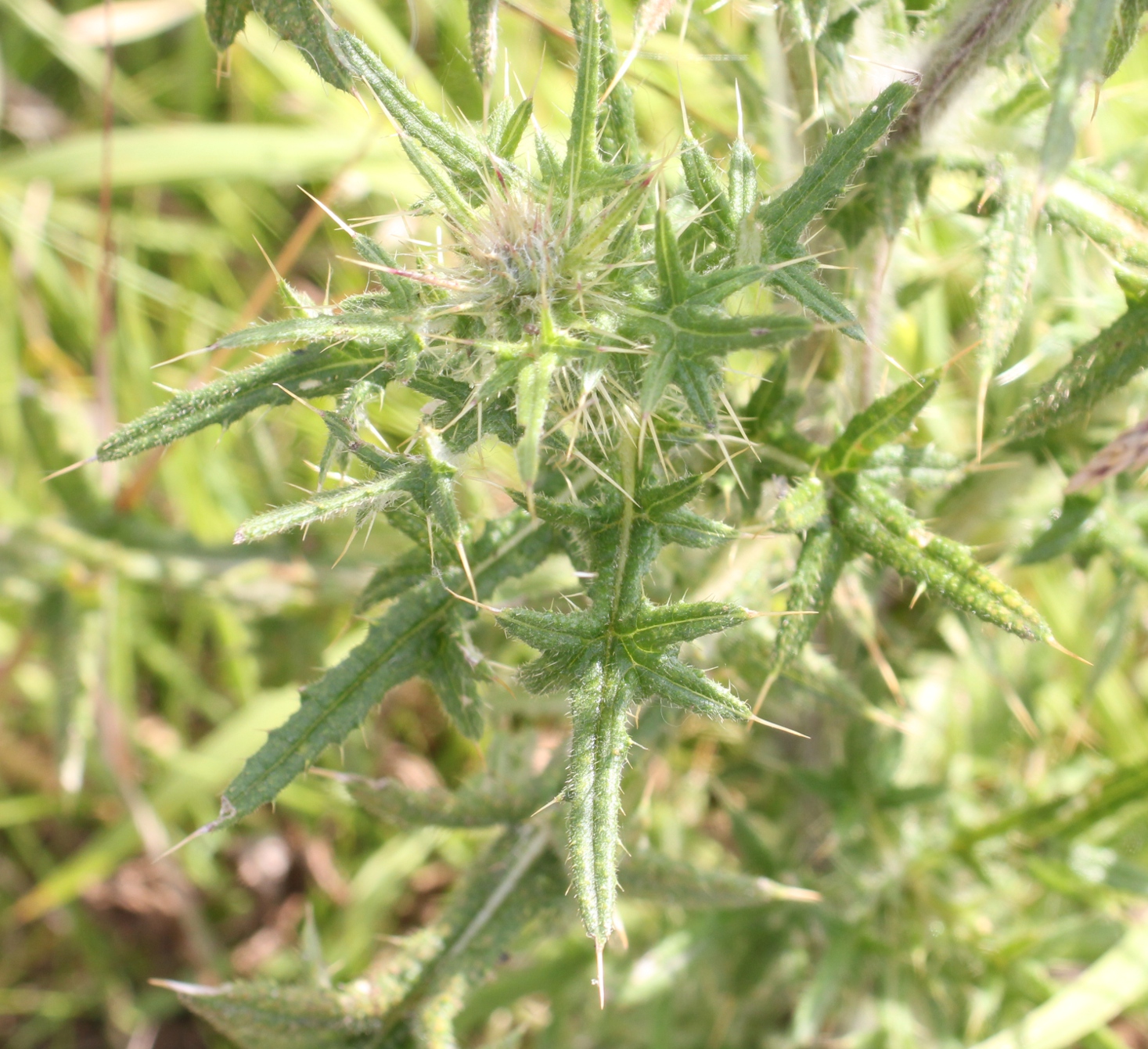
The first specimen I am not entirely sure on the ID. I have added it to iSpot as a possible Plymouth Thistle (Carduus pycnocephalus), but this is quite rare/causal outside of the Plymouth area so I have my doubts. So far it is two-a-piece for Plymouth Thistle and Creeping Thistle (Cirsium arvense). If anyone has any ideas on the ID then please add it to the comment section. It had some winged spines on the stem, which Creeping Thistle isn't meant to have, but equally the involucral bracts look too short for Plymouth Thistle, making me doubt my initial ID.


I have been reliably informed via iSpot that the next thistle is Creeping Thistle. You will notice that the flower heads are very similar to the first thistle above.

Cirsium arvense
Cirsium arvense
Cirsium arvense
Cirsium arvense
The last thistle I noted before leaving was Spear Thistle (Cirsium vulgare). The flower head on this plant was obviously larger. The leaves were hairy and spear like in shape.

Cirsium vulgare


Obviously all of these flowering thistles were bound to attract some insects. One of these was a very pretty (or should I say handsome) bee feeding on the thistles. Due to the wind I struggled to get any photos that would do it justice. It turned out that it was a male Large Red Tailed Bumble Bee (Bombus (Melanobombus) lapidarius).

 (Bombus (Melanobombus) lapidarius)
 (Bombus (Melanobombus) lapidarius)
I thought that the workers were pretty but the male bee is really stunning.

I also observed a fair few Small Skipper (Thymelicus sylvestris) butterflies feeding on the thistles. Below is a male Small Skipper.

Thymelicus sylvestris
The Small Skipper is very similar to Essex Skipper (T. lineola) but the males can be told apart by the difference in size and shape of the male sex-brand. The sex-brand is the black line running through the middle of the fore-wing, but ending before it reaches the tip. It is longer and more distinct in Small Skipper.

Back to plants and I was quite excited to find this little gem of a plant (below) hiding away amongst some grasses. I didn't have a clue what it was, but it didn't take long for an iSpot member to identify it as Selfheal (Prunella vulgaris). Apparently most of the flowers had fallen off but I still thought it looked rather nice.

Prunella vulgaris
Prunella vulgaris
Now I have come to the end of this "little" post so I would just like to take the opportunity to thank all the members of iSpot that have helped to identify, or confirm the identity of many of my sightings. Without their help and support I would not be able to put names to some of these photos, and the blog would be much poorer as a result.

Tuesday, 28 June 2011

Palmate Newt 28th June 2011

Today I found a young Palmate Newt (Lissotriton helveticus) in my Garden. This is the first time I have ever found a newt in my garden. I get lots of Common Frogs (Rana temporaria) which unfortunately the cats like playing with, but never a newt before. I know there are a few ponds nearby so they must be coming from these. I would like a pond but living in rented accommodation means that I'm not able to add one.

Lissotriton helveticus
I was able to entice this little newt into my garden by putting some cover down for it in a damp shady patch under a large tree. This cover came in the form of an old rubber bin lid which had seen better days.

Old rubber bin lid which has seen better days
It has been said that you cannot separate out immature smooth newt from immature palmate newt, but the following article on iSpot shows that you should be able to with relative ease: ispot.org.uk

The more observant of you might note the vast swathes of chickweed that I have let grow in this part of the garden. A common frog was hiding from the cats in this extensive green cover (which even the most observant of individual wouldn't be able to see in the photo).

I have found that if you can't afford to buy lots of plants for the garden then you might as well let the weeds grow a bit. Don't get me wrong I do carry out some weeding, but a monoculture of chickweed is better than barren soil for wildlife, even if it looks less tidy to some. I only let the chickweed take over in this shady patch, where it goes a little more unnoticed. I also have some wild Feverfew (Tanacetum parthenuim) growing in the garden, and these make a lovely substitution for bought plants.

When the weather has been dry like it was last spring, areas of bare soil in the garden got baked dry, but where there was extensive vegetative cover there was plenty of moisture left in the soil, and the insects were taking full advantage of this. Now that we are into summer and we have had some rainfall, areas like this are proving very useful refuges for amphibians too as the plants help retain the moisture from that rainfall. It only takes a few hours of sunlight in the middle of summer to dry out bare soil, even after a heavy shower or two.

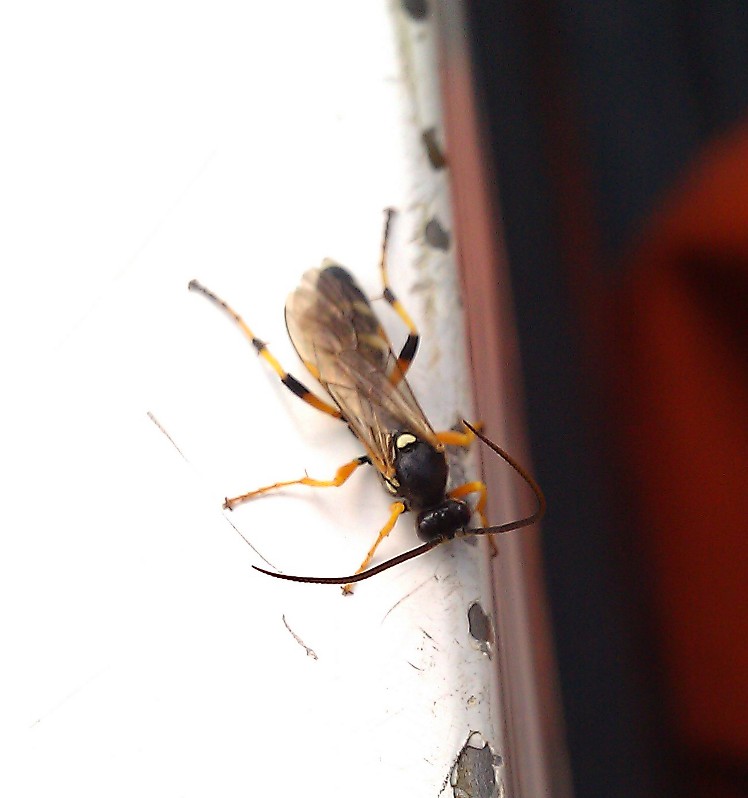
I have been busy with other things lately (namely work and resting from work), but I did get over to Highgate Common again on Tuesday to help with the work party there. We cleared another large section of Bracken from the damp heathland in the north of the reserve. While waiting for all the other volunteers to arrive in the warden office car park we spotting a couple of interesting insects. There was a Broad-barred White moth (Hecatera bicolorata) on the brickwork of the warden's office, and also an Ichneumon wasp landed on the warden's pick-up truck. I believe that the wasp was Ichneumon sarcitorius but I haven't had that verified by an expert yet. I didn't have my camera with me at the time but I managed to make do with my phone. Luckily they both stuck around long enough so that I could play with the settings on the phone's camera.

Ichneumon sarcitorius?
Hecatera bicolorata
I think that they didn't turn out too badly in the end to say they were taken on a camera phone. The reason I think the wasp is Ichneumon sarcitorius is because the leg, antennae and thorax markings are the same as on  the picture here: natureconservationimaging.com