Tuesday, 5 July 2011

Belvide 2nd July 2011

On Saturday I was up at 4am eagerly anticipating my first ever bird ringing session. Nothing much else could have gotten me up at that time in the morning and I was very tired, but excited nonetheless.

I have been trying to attend one of these ringing sessions for some time but work and a bout of flu put paid to my plans of attending in the spring.

Before I get into details though, I guess I should give a little background information for those interested.

Belvide Reservoir is one of five bird reserves run by the West Midlands Bird Club (WMBC). To get access to the reserve you must be a WMBC member. Inclusive membership with a permit for the reserves currently costs £30 per calender year. See their website WMBC for more details.

Cumulonimbus cloud passing over Belvide

There is a brilliant blog for bird sightings at Belvide that gets updated daily by Steve Nuttall. This can be found at Belvide Birding. I really appreciate Steve's efforts in keeping the blog up to date each day, especially now I know the work involved in keeping a blog running myself. 

For those that don't know what bird ringing is there is an FAQ on the BTO website here

There is also a link on the website above for you to locate and contact your nearest trainer. Ringing birds requires a detailed knowledge of birds, a skilled hand for handling them and as birds are protected under the Wildlife and Countryside Act, you also need a licence to trap and ring them.

In order to obtain a license which allows you to ring unsupervised you must first be trained by such an experienced person. It can take up to a couple of years for you to obtain a C licence depending on how much free time you and the trainer have for training sessions. The C licence enables you to ring birds by yourself, but under the remote supervision of your trainer.

In my case my nearest trainer is part of the Brewood Ringers Group and they do regular ringing sessions over at Belvide. Their website and blog is located at http://brewoodringers.com/

I arrived at Belvide Reservoir at bang on 5am to meet up with the ringing group in the car park. Including myself there were only the 3 of us initially, although they often get more people in attendance.

It started off rather cold as there had been a clear sky and light wind all night. It did get sunny and warm later on in the morning though. Peter Bache and Collin McShane went about setting up the nets for the days ringing session. The nets look like big badminton nets, but they have a much finer mesh that the birds find difficult to see and they also have pockets in them made out of the net material for the birds to fall in.

It is very tricky getting the birds out of the nets and it takes a very skilled hand to retrieve the birds from the nets without injuring them. Once a bird was removed from the net it was then placed into a soft, dark bag so that it could be taken back to the ringing station. We visited each net approximately every 20-30min to check for new birds. Once we had checked all of the nets we would then take the birds back to the ringing station (patio furniture). If a bird already had a ring on it, the ring would be checked to see if it was recent. If the ring was recent then it would get released straight away without being placed in a bag.

If a bird didn't have a ring on it, then one would be assigned to that bird and then attached to it's right leg. A record of the ring number, the species of bird, the approximate age of the bird (immature/adult) and if known, the sex of the bird was all made in a log book.

If a bird was a re-trapped bird, then again the same records were made, but without the addition of another ring.

The main benefit from ringing birds comes from re-trapping birds that have already been ringed. Things like time since last capture and distance travelled from the site of last capture can then be worked out. By having a network of constant effort ringing sites and bird observatories across the world, Ornithologists were able to determine approximate migration routes for migratory birds long before the days of GPS.

As this was my first session I wasn't able to remove any of the birds from the nets, but I was allowed to handle and ring the birds under supervision once we got back to the ringing station.

We had a lot of Sedge and Reed Warblers but not much else. There was the occasional Blue Tit, Great Tit and Chiffchaff etc. but numbers were quite low. This didn't really trouble me though as I didn't want to be swamped by lots of birds on my first day.

Reed Warbler
Acrocephalus scirpaceus

For a list of the birds we caught see here

Most of the birds were fine to handle but the Blue Tits and Great Tits were a bit of hand full and not in a nice  way ;) They were quite aggressive and kept pecking at my fingers!

Overall though it was a very enjoyable experience and one I look forward to repeating in the near future as I attempt to gain my ringing licence.

Tuesday, 28 June 2011

Palmate Newt 28th June 2011

Today I found a young Palmate Newt (Lissotriton helveticus) in my Garden. This is the first time I have ever found a newt in my garden. I get lots of Common Frogs (Rana temporaria) which unfortunately the cats like playing with, but never a newt before. I know there are a few ponds nearby so they must be coming from these. I would like a pond but living in rented accommodation means that I'm not able to add one.

Lissotriton helveticus
I was able to entice this little newt into my garden by putting some cover down for it in a damp shady patch under a large tree. This cover came in the form of an old rubber bin lid which had seen better days.

Old rubber bin lid which has seen better days
It has been said that you cannot separate out immature smooth newt from immature palmate newt, but the following article on iSpot shows that you should be able to with relative ease: ispot.org.uk

The more observant of you might note the vast swathes of chickweed that I have let grow in this part of the garden. A common frog was hiding from the cats in this extensive green cover (which even the most observant of individual wouldn't be able to see in the photo).

I have found that if you can't afford to buy lots of plants for the garden then you might as well let the weeds grow a bit. Don't get me wrong I do carry out some weeding, but a monoculture of chickweed is better than barren soil for wildlife, even if it looks less tidy to some. I only let the chickweed take over in this shady patch, where it goes a little more unnoticed. I also have some wild Feverfew (Tanacetum parthenuim) growing in the garden, and these make a lovely substitution for bought plants.

When the weather has been dry like it was last spring, areas of bare soil in the garden got baked dry, but where there was extensive vegetative cover there was plenty of moisture left in the soil, and the insects were taking full advantage of this. Now that we are into summer and we have had some rainfall, areas like this are proving very useful refuges for amphibians too as the plants help retain the moisture from that rainfall. It only takes a few hours of sunlight in the middle of summer to dry out bare soil, even after a heavy shower or two.

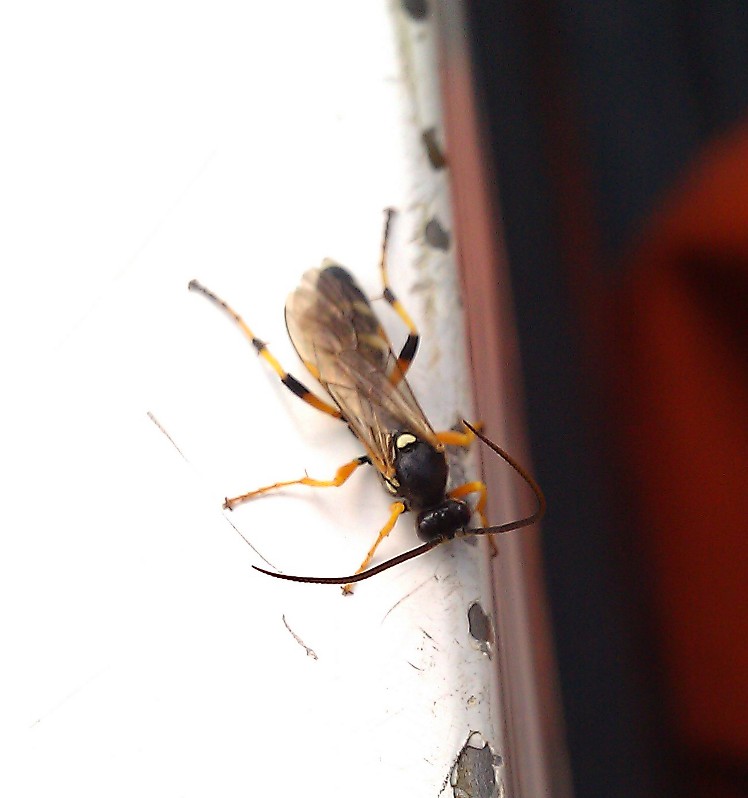
I have been busy with other things lately (namely work and resting from work), but I did get over to Highgate Common again on Tuesday to help with the work party there. We cleared another large section of Bracken from the damp heathland in the north of the reserve. While waiting for all the other volunteers to arrive in the warden office car park we spotting a couple of interesting insects. There was a Broad-barred White moth (Hecatera bicolorata) on the brickwork of the warden's office, and also an Ichneumon wasp landed on the warden's pick-up truck. I believe that the wasp was Ichneumon sarcitorius but I haven't had that verified by an expert yet. I didn't have my camera with me at the time but I managed to make do with my phone. Luckily they both stuck around long enough so that I could play with the settings on the phone's camera.

Ichneumon sarcitorius?
Hecatera bicolorata
I think that they didn't turn out too badly in the end to say they were taken on a camera phone. The reason I think the wasp is Ichneumon sarcitorius is because the leg, antennae and thorax markings are the same as on  the picture here: natureconservationimaging.com

Thursday, 23 June 2011

Highgate Common 20th June 2011 part 2

Part 2


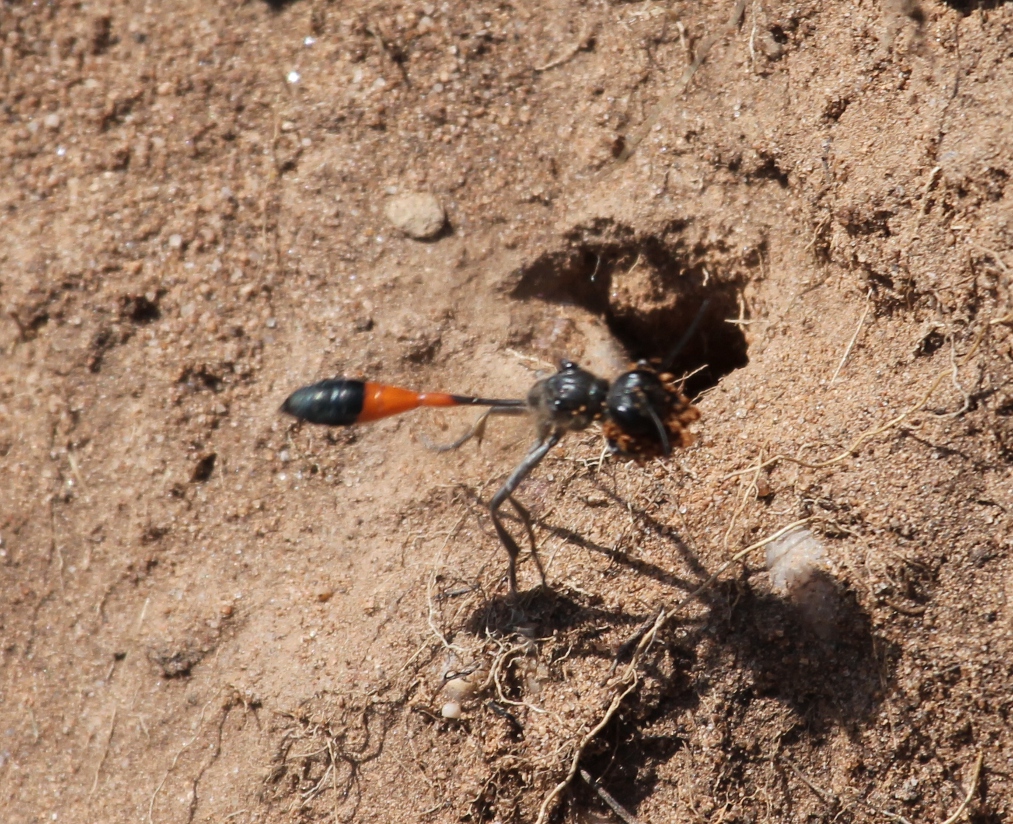
I continued to scan the bee beaches for signs of activity and managed to find a Sand Digger Wasp going in and out of a hole. I watched it for a while and realised that it was actually in the process of excavating its nesting hole. Each time it came out of the hole it would have a lot of sand in its mandibles. It would then fly off  a short distance to drop the sand. I even heard it drop a very small stone on the one drop off flight.

Ammophila sp.
Ammophila sp.
There were also some Nomada Sp. of Cuckoo Bee scouting around for other bee's nests to lay their eggs in (hence the name).

Nomada Sp.
Nomada Sp.
I didn't see much more activity so rather than looking at potential nest sites I switched to looking at nectar/pollen sources. The brambles were in flower and were a hive of activity. I couldn't keep up with the amount of bees and wasps coming and going.

I saw a Cuckoo bumblebee which was either Gypsy Cuckoo Bee (Bombus bohemicus) or Southern Cuckoo Bee (Bombus vestalis). Once again, as the name suggests these bees lay their eggs in the nests of other species. Vestalis lays its eggs in terrestris nests, whereas bohemicus takes over the nests of locurum. I think this was probably vestalis as I also took a photo of Bombus terrestris (second photo, also known as Buff-tailed Bumblebee). I don't know if Bombus locurum (White-tailed) occurs on Highgate or not though so I still can't rule out bohemicus. The two species are very similar - see the BWARS site for bohemicus and vestalis.


Bombus bohemicus/vestalis
Bombus terrestris
 I have been told that the smaller insect in the photo below could be a Common Spiny Digger Wasp Oxybelus uniglumis.


Bombus terrestris and Oxybelus uniglumis?
Apparently uniglumis is one of the fastest wasps around. See: www.natureconservationimaging.com

As I have probably mentioned before, bees and wasps are a speciality of Highgate with up to 139 species of aculeate hymenoptera occurring on the site. Aculeate roughly translates to  "with a sting" and so only covers those hymenoptera that posses a sting. As far as I can make out, the classification of hymenoptera is currently under review so this grouping may no longer be considered correct.

It has been well publicised that Honey Bees (Apis mellifera) have been undergoing a rapid decline in numbers recently. I did manage to see some over Highgate though, so at least some hives are still going. Not much is known about their decline, but some attribute it to new types of pesticides called neo-nicotinoids. These have already been banned in many countries as a result.

Apis mellifera
I saw another species of mining bee that I haven't seen before; it has been suggested that it could be Andrena (Simandrena) dorsata. This bee is quite obviously different to the grey and black mining bees that also occur on the site.

Andrena (Simandrena) dorsata?
The following are not the best of photos, but they are my only photographic record of a Cerceris sp. of  digger wasp on Highgate so far, probably Cerceris rybyensis. These prey on mining bees like the one above. See: www.natureconservationimaging.com for more information (a fantastic website by the way).

Cerceris rybyensis?
Cerceris rybyensis?
Cerceris rybyensis?
I also managed to grab a photo of a type of carder bee (Bombus (Thoracobombus)) and one of my favourite bees - a Red-tailed Bumblebee (Bombus (Melanobombus) lapidarius).

Bombus (Melanobombus) lapidarius
Bombus (Thoracobombus)
Moving back to butterflies but with a bee type twist. Whilst taking photos of Large Skipper butterflies (Ochlodes sylvanus) I also managed to get a possible crabronid wasp in the same photo. Another two for one in the same day :)

Ochlodes sylvanus and possible crabronidae
Ochlodes sylvanus
Ochlodes sylvanus
The male Large Skipper can be told from the female by the black line in the middle of each forewing (first photo).

I also managed to take a photo of a rather odd looking fly, which was a type of Robber fly (Asilidae).

Asilidae

Monday, 20 June 2011

Highgate Common 20th June 2011 part 1

I'm going to be splitting this trip into two sections as it is quite long. Here is part 1, enjoy!

I went for another walk over Highgate Common this morning in search of the Longhorn Beetle (Agapanthea villosoviridescens) we found last week. However, trying to find one bug in a large area didn't turn out so well and I failed to re-find it. I decided instead to just go on a long walk across the Common and photograph whatever I came across instead.

I did find some butterflies in the same area. There was a Common Blue (Polyommatus icarus), Small Heath  (Coenonympha pamphilus) and some Ringlets (Aphantopus hyperantus) flying around.

Polyommatus icarus
Polyommatus icarus
Coenonympha pamphilus
Aphantopus hyperantus
There was also a species of Grasshopper present that I managed to photograph, but I haven't managed to ID it yet and a female Common Blue Damselfly (Enallagma cyathigerum).

Enallagma cyathigerum
Unknown Grasshopper 

I also took the opportunity to photograph the Tree Pipits (Anthus trivialus) and Whitethroats (Sylvia communis) that we saw last week.

Anthus trivialus
Sylvia communis
I then went-a-wondering towards one of the small ponds on Highgate. However, just as I got there a dog decided to take a bath. The owner of the dog was also quite happy to let it drink the stagnant water, no wonder the dog started to have a coughing fit!

Despite this disturbance I did manage to get a photo of an Azure Damselfly (Coenagrion puella). There was some kind of large blue dragonfly patrolling the pond but it never landed for me to get a photo, thus I'm not sure of the species.


Coenagrion puella

The White Water-lilies (Nymphaea alba) were out in flower and I managed to grab a quick photo before said dog arrived on the seen.

Nymphaea alba
After the quick trip to the pond I decided to hunt down some bees again by visiting the "bee beaches" and natural bare soil to the north and west.

On visiting one of the bee beaches I was very pleased to see my first Bloody-nosed Beetles (Timarcha tenebricosa). I thought at first that I was seeing an oil beetle, but the realised on closer inspection that it I had caught two Bloody-nosed Beetles mating. Two for the price of one :)

Timarcha tenebricosa

Timarcha tenebricosa

I was hoping to see a black mining bee (andrena nigrospina) but it looks like I'll have to put in some more leg work on that one. I'm told it's still early in the year for them so hopefully further visits might be more fruitful.

Look out for part 2...


Tuesday, 14 June 2011

Garden 13th June 2011

I haven't been up to much recently as the weather hasn't been the best on my days off. I did go to Highgate Common again today to do some more volunteer work, but bracken clearing doesn't really mix that well with photography. We did see a longhorn beetle (Agapanthia villosoviridescens) which was a nice find, there was also a family of Common Whitethroats flitting around the heather, some Tree Pipits were doing their parachuting display flight and we saw a sand digger wasp.


I managed to get out in the garden yesterday and take a few photos. The light wasn't good but I did capture some resonable images of two species - Arge pagana a Rose sawfly and Bombus hypnorum, the Tree bumblebee.


The Tree bumblebee is a newcomer to these shores, having arrived from off the Continent in 2001.  It has since quickly spread north. The Bumblebee Conservation Trust is interesting in mapping its progress across the UK, so if you see it you can report it to them here: http://www.bumblebeeconservation.org.uk/tree_bee.htm

It is easy to identify as it is the only species of bumblebee in the UK with a brown/ginger thorax, black abdomen and white tail. However, the individual I found was rather dark. 


John

Friday, 10 June 2011

Highgate Common 4th June 2011

Rebecca and I went for a trip over Highgate Common last weekend to take some photos of the insects there.

We didn't see as many insects as we would have liked as the weather took a turn for the worse after such a promising start. When we got up at about 11am (we were having a lazy day) it was hot and sunny, but when we were ready to go out it had clouded over and the wind had picked up. By the time we had finished our walk it was starting to rain.

The best location we found was a bare patch of ground on a footpath, which had obviously been kept clear of vegetation by the many visitors to the reserve over the last weeks, months and years. Despite this disturbance there were many holes in the ground which bees and wasps had dug to make their nests. Here we saw Grey Mining Bees and another bee of the genus Sphecodes.

I think what also made this area ideal for bees was that it was on a warm SSW facing slope. Many mining bees seem to really like warm sunny areas, maybe because it helps to keep the soil dry?
 
The wardens at Highgate have also created some "Bee Beaches" but they didn't seem to be a hive of activity when we visited. It could be because plants had started to grow in what should have been bare ground or it could simply be that we were unlucky not to see anything buzzing around at the time.

In and around the same area of the Common we also found a Garden Chafer climbing up some grass. I also managed to get it to climb up my hand so I could get a closer look.


A Buff-tailed Bumble Bee landed on the footpath looking a little worse for wear. Despite the picture I don't think they like making there nests in bare, sandy ground like the Grey Mining Bee.

A little way further on our walk and we spotted a day flying moth. This was a Six-spot Burnet moth. These closely resemble Cinnabar moths but as the name suggests they are more spotty. It decided it liked the look of my jeans so I had to get Rebecca to take the photo.

I hope you enjoy the pictures.

Thanks for reading, John.

Monday, 30 May 2011

Volunteering

Last Tuesday I did my first stint volunteering at Highgate Common.

Since 2009 the Staffordshire Wildlife Trust have taken over management of the reserve and they seem to have done wonders with the site already since taking it on.

 I found volunteering at Highgate thoroughly enjoyable and very rewarding. A small group of us met up at the Warden's office at 10am, everyone seemed very nice and welcoming, and were pleased to see a new face.

The order of the day was Himalayan balsam removal, which needed to be pulled from an area of the common where they have been trying to set up a butterfly glade in the woodland. Himalayan balsam is a very invasive introduced plant species which can take over the field layer of a site if left to its own devices.

It was hard work pulling up all of the plants, but they came up easily enough due to their shallow roots and we had a couple of lengthy breaks to give us all a breather. Tea, coffee and snacks were all provided, but you had to bring your own lunch.

We came across some interesting insects whilst doing the work, and this is one of the things Highgate Common specialises in. Particularly memorable were a couple of wasp beetles that we found on some old tree stumps. It is also meant to be very good for solitary bees and wasps, but we were in the wrong area of the reserve to see many of these because they prefer the heathland/grassland areas, where there is more bare soil for their nests. I look forward to going on a site visit some time soon to try and spot some of these (as well as get some photos).

For anyone that is interesting in volunteering I would definitely recommend it and I look forward to doing it again. There are wildlife trusts up and down the UK (47 in total) and they all welcome volunteers. I found out about the Highgate Common work party through their website at http://www.staffs-wildlife.org.uk/article/volunteering-event/view/highgate-common-workparty

To find your local trust go to http://www.wildlifetrusts.org/index.php?section=localtrusts

John